


The Advocates for Human Rights Documents Ongoing Restrictions on Public Access to Immigration Court
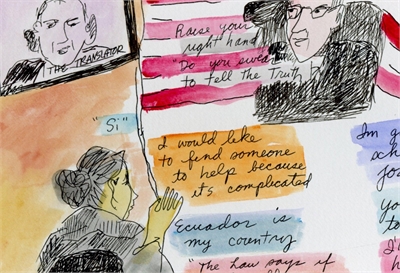
Transparency is essential to a functioning court system, but immigration courts routinely fail to live up to this democratic principle. Federal regulations state that immigration court hearings are presumptively open to the public, allowing for closed hearings only in specific circumstances. Yet, The Advocates for Human Rights and court observers across the country have documented immigration courts repeatedly restricting public and press access to hearings without justification.
As the administration continues to roll out policies that make it harder for people to have a fair day in court, this practice raises the question: how do we know the government is respecting due process and the rule of law if we cannot see what it’s doing?
Background
Since 2017, The Advocates for Human Rights has operated an Immigration Court Observation Project, sending trained volunteers and staff to observe and document removal and bond proceedings at the Fort Snelling Immigration Court. This human rights monitoring follows established international best practices and, until 2025, operated with the court's cooperation.
In early 2025, observers began to face restrictions at Fort Snelling like locked courtroom doors during scheduled hearings and judges’ refusal to allow observers onto virtual Webex hearings.
In March 2026, the Advocates for Human Rights filed a federal lawsuit challenging these restrictions. More than 4 months later, these problems continue.
Lawsuit Documents Restrictions Across the Nation
As the case continued, court observers from around the country facing the same restrictions in their immigration courts joined our lawsuit. We were even supported by declarations from four former immigration judges who explained the importance of open, transparent immigration courts. Read the declarations here.
Observer access to immigration hearings is essential because it helps to ensure courts respect due process and treat immigrants with dignity. Observers also document new practices in court that put human rights at risk.
"Mega Masters” is one such practice, a tactic being used around the country to speed up court timelines, making it harder for immigrants to prepare for their day in court. Unlike ordinary master calendar hearings in which an immigration court may hear a dozen or so cases, courts are now scheduling 100 or more people for the same initial hearing time, creating chaos in the courtrooms and crowding out room for court observers. Many people are not getting adequate notice of their changed hearing time, causing them to miss the hearing, which allows the government to deport them without a full trial. Court observers can help document these due process violations, especially since many people scheduled for Mega Masters do not have legal representation.
Another practice is the so-called “Somali Rocket Docket.” The government has been scheduling Somali asylum seekers who live in Minnesota for remote court proceedings with judges in other states. These hearings are also on a compressed timeline, making it harder to prepare asylum cases. It is essential that observers be present to document the impact of this practice that discriminates against one nationality.
Restrictions at the Fort Snelling Immigration Court
However, court observers face major restrictions observing hearings, allowing potential human rights violations to occur undetected.
From February to May 2026, the Advocates for Human Rights documented courtroom access restrictions at Fort Snelling on over 50% of weekdays nearly every month.
Monthly Frequency of Courtroom Access Restrictions (2026)

Court observers also struggle to observe the Somali Rocket docket. Out of a total of 692 hearings that observers have attempted to join virtually on Webex, they have been excluded from over 95%.
Observer Access to MN-Based Webex Hearings (2026)

We need to be able to see what is happening to judge whether our country’s laws, policies, and elected officials represent our values. Without public access to immigration court hearings – access that is required by regulation – we can’t see the human impact of the administration’s mass deportation agenda and radical reinterpretation of immigration laws. Court observation is an essential tool in a democracy, and The Advocates will keep fighting for public and press access to the immigration courts.
by Zoe Martens